Quick summary
- Registration: new services apply to Tusla at least three months before opening; staff working directly with children need at least a Level 5 major award in ECCE.
- Ratios: minimums range from 1:3 for under-ones to 1:8 for three-to-six-year-olds in full daycare (Schedule 6, Early Years Services Regulations 2016).
- Vetting: everyone in direct contact with children needs Garda Vetting Disclosure before they start, renewed every 36 months.
- Curriculum & quality: Aistear (what children learn) and Síolta (the quality of the service) work together, not as alternatives.
- Funding: ECCE (universal preschool hours), Core Funding (paid to the service) and NCS (subsidy paid via the parent's CHICK code) are three separate schemes that often apply to the same child at once.
- Inspection readiness is mostly about consistency between your records: attendance, fees, care plans and vetting all telling the same story, not any single document.
Registering and regulating your service
Tusla's Early Years Inspectorate registers and regulates every pre-school and school-age childcare service in Ireland under the Child Care Act 1991 (Early Years Services) Regulations 2016. If you're setting up a new service, the application has to go in at least three months before you plan to open (21 days for a temporary service), and it needs to be complete when submitted as Tusla automatically closes applications left incomplete for more than ten days, without a refund.
Every employee and registered provider working directly with children needs a minimum of a Level 5 Major Award in Early Childhood Care and Education on the National Framework of Qualifications, or an equivalent recognised by the Minister. Have your documentation ready before you start the application, not gathered as you go: qualifications, references, Garda vetting, insurance, fire safety, floor plans.
Once registered, your service appears on Tusla's public Register of Early Years Services and is subject to ongoing, largely unannounced inspection against the same regulations. Registration isn't something you do once and forget. Services go through periodic re-registration, so the records that got you registered the first time need to still be accurate later.
A dedicated guide to the registration process covers timelines, required documents and common delays in more depth, and our practical checklist for preparing for a Tusla inspection covers what happens once you're up and running.
Two other registration-adjacent things trip up new services more often than the paperwork itself. First, public liability and employer's liability insurance need to be in place before you open, not arranged around the same time. Tusla will ask for evidence of cover as part of the application. Second, once registered, certain events have to be reported to Tusla as they happen rather than waiting for the next inspection: serious injuries, allegations of abuse, and significant changes to the service (a change of provider, a change to the premises, or a change to the number of registered places) all count as notifiable events. Treat notification as a standing obligation, not an inspection-time task.
Staffing: ratios, qualifications and vetting
The adult-to-child ratios in Schedule 6 of the 2016 Regulations set the minimum number of adults required in a room at any given time. They have to be maintained for every session, not just planned for on a rota, including when someone is on a break or arrives late.
| Age group | Minimum ratio (full daycare) |
|---|---|
| Under 1 year | 1 : 3 |
| 1–2 years | 1 : 5 |
| 2–3 years | 1 : 6 |
| 3–6 years | 1 : 8 |
| 2y6m–6 years, sessional (under 3.5 hrs) | 1 : 11 |
Minimums from Schedule 6 of the Child Care Act 1991 (Early Years Services) Regulations 2016. Always check the current regulation and any amendments before relying on these figures for a compliance decision.
Garda vetting is a separate, legal requirement under the National Vetting Bureau (Children and Vulnerable Persons) Acts 2012-2016. It has to be completed before someone starts, and it applies more broadly than most new owners expect, not just paid staff but students on placement, volunteers, contractors and Board of Management members if they're in direct contact with children. Vetting is renewed every 36 months, not a once-off, and it typically takes 8-10 working days to come back, so build it into your onboarding timeline instead of leaving it as a last step. As of early 2025, Early Childhood Ireland administers vetting for employees of early learning and school-age care services, while Tusla handles vetting for registered providers, childminders and Board chairpersons directly.
A full breakdown of qualification requirements, and a practical staff onboarding checklist, are covered in our Staff & HR cluster.
Curriculum and quality: Aistear and Síolta
Aistear and Síolta are the two frameworks every Irish early years practitioner will hear about constantly, and they're often mentioned as if they're interchangeable. They aren't. Each answers a different question.
Aistear, developed by the NCCA, is the curriculum framework for children from birth to six. It describes what children learn and how, organised around four themes: Well-being, Identity and Belonging, Communicating, and Exploring and Thinking, each with four aims and six learning goals. It's the framework behind your planning and your observations.
Síolta is the national quality framework. It describes the standard of the service itself: 12 principles, 16 standards and 75 components covering everything from relationships and interactions to environment, health and safety, and management. Where Aistear asks "what is this child learning," Síolta asks "is this service being run well."
In practice, most settings use both together: Síolta shapes policies, environment and practice standards; Aistear shapes what happens in the room and what gets recorded in each child's observations and learning stories.
Deeper articles on planning with Aistear, recording observations, and learning stories are in our Aistear & Síolta cluster.
Funding: ECCE, Core Funding, NCS and AIM
This is the area that generates the most confusion, mainly because the schemes were introduced at different times, are administered by different bodies, and use overlapping language. Here's how they differ.
| Scheme | What it is | Who administers it | Paid to |
|---|---|---|---|
| ECCE | Universal free preschool programme, 3 hours/day, 5 days/week, 38 weeks/year, across two programme years | Department of Children, Disability and Equality | Service (capitation) |
| Core Funding | State funding based on a service's staffed capacity, supporting sustainability and fee caps | Department of Children, Disability and Equality / Pobal | Service (base rate) |
| NCS | Universal and income-assessed subsidy for children 24 weeks–15 years, claimed via a CHICK code | Pobal | Service, on behalf of the parent |
| AIM | Access and Inclusion Model: seven levels of support so children with disabilities can take part in ECCE | Department of Children, Disability and Equality / Better Start | Service or specialist support, per child's needs |
ECCE gives every eligible child 15 hours a week of free preschool across two full programme years, running 1 September to 30 June. A child is eligible to start once they've turned 2 years 8 months by 31 August, and every child gets two full years before starting primary school. The rate is €64.50 per week.
Core Funding is paid directly to services, mainly through a base rate tied to opening hours, weeks of operation, age group and registered capacity. It's the mechanism behind the maximum fee caps you'll see referenced in the press each year. For the current programme year the cap for a full-time place of around 45 hours a week is €183.70, down from roughly €198 the year before, alongside a jump in total Core Funding to over €480 million.
NCS is the subsidy families apply for directly through Pobal. Once approved, the parent receives a CHICK code (Childcare Identifier Code Key), a unique reference tied to their child's award, which they give to you. You use it to claim the subsidy and reduce what the family pays on their invoice. The rate starts at €2.14 per hour but may be higher for some children.
AIM supports children with disabilities to participate in ECCE, through seven levels of support. Levels 1-3 are universal, covering CPD, an Inclusion Charter, and an Inclusion qualification for staff, and benefit the whole setting. Levels 4-7 are targeted and applied for per child: Level 4 brings in a Better Start Early Years Specialist to build an Access and Inclusion Plan, Level 5 covers equipment or minor building grants, and further levels can provide specialist advice, therapeutic input, or additional in-room assistance.
What catches services out is rarely any individual scheme. It's the overlap between them. A child can be enrolled under ECCE for their free preschool hours and have an NCS award covering additional hours in the same week, but the two need to be tracked as genuinely separate blocks of time. If ECCE hours get counted again under the NCS claim, that's a double-claim. It's exactly the kind of thing an NCS inspection report is designed to catch, and you'll have to repay any over-claim. The safest approach is to record attendance once, at the actual time it happens, and let your fee and funding calculations derive from that single record rather than being entered separately for each scheme.
Full articles on ECCE, Core Funding, NCS and AIM individually, including how ECCE and NCS hours interact without double-counting, are in our Funding cluster.
Attendance and records
Tusla inspectors, and the NCS compliance process, both come back to the same underlying question: does your paperwork actually reflect what happened? An attendance register that's filled in at the end of the week from memory won't hold up the same way as one completed at the point of drop-off and collection, with a timestamp and the staff member's name attached.
For NCS specifically, attended hours are tracked against the hours a parent's award is based on. If a child misses their claimed NCS hours for eight consecutive weeks without the change being reported, it becomes a compliance issue for both the service and the family. They then enter a four-week window to make the correction (hit their weekly hours) before it needs to be actioned formally, which means reducing the chid's NCS hours to the new level.
Beyond attendance, the records Tusla and funding bodies expect to see on request typically include: a signed enrolment form per child, individual care plans for any allergy or medical condition, an up-to-date register of authorised collectors, accident and incident logs, staff qualification and vetting records, rotas showing ratio coverage, and evidence of parental consent for things like photography, outings and medication administration. None of these need to be elaborate, but they need to be kept current and consistent with each other.
Recording attendance correctly, authorised collectors, and what to do about missed NCS hours are covered in our Attendance cluster.
Parent communication
None of the above matters much to a parent day-to-day, what they want is to know their child had a good day! Most compliance-relevant records (attendance, care plans, consent) also happen to be the same information parents want visibility of. That overlap is why services that keep parents well informed tend to also keep the cleanest records: it's largely the same underlying data, just presented for two different audiences.
More on daily updates, incident reporting and consent is covered in our Parent Communication cluster.
Preparing for inspection
Do the things above consistently and inspection preparation largely takes care of itself. The services that find inspections straightforward tend to share a few habits:
- Attendance records match fee schedules and NCS claims for the same period.
- Care plans and consents are current, not just completed once at enrolment.
- Vetting and qualification records are up to date, with renewal dates logged somewhere, not left to memory.
- Ratios can be shown to have held for every session, not just planned for.
- Policies exist, are dated, and reflect what happens in the service.
Common mistakes, based on what comes up
A few issues turn up repeatedly across services of every size, and most are avoidable with a small process change, not more paperwork:
- Vetting renewal dates aren't tracked centrally. Vetting doesn't lapse loudly, it just quietly goes out of date until someone asks. Track the 36-month renewal date the same way you'd track a fire safety certificate (assuming you track that carefully...!).
- Care plans are signed once and filed. A plan agreed at enrolment and never revisited is technically on record but may no longer be accurate, and Tusla's guidance expects current information, not historical information.
- Ratios are planned for, not verified in the moment. A rota can show correct ratios on paper while the room runs short-staffed because of a late arrival, a sick day, or a longer-than-planned break. What matters at inspection is what actually happened, not what was scheduled.
- ECCE and NCS hours are entered into two separate systems. Even with good intentions, manually re-entering the same attendance into two different calculations is where double-counting creeps in.
- Notifiable events are reported late. Because they're infrequent, it's easy to default to "we'll mention it at the next inspection" instead of notifying Tusla at the time, which is what's required.
Practical advice: where to start
If you're setting up a new service, start with registration timelines and staffing, everything else depends on being registered and correctly staffed. If you're running an existing service and this feels overwhelming, don't try to fix everything at once. Pick the area where your records are weakest, usually attendance or care plans, and get that consistent first. A handful of records that are reliably accurate will get you further at inspection than a thick folder of paperwork that's technically there but out of date.
How Tot Tracker helps
Tot Tracker doesn't replace any of the above, Tusla still inspects, Pobal still administers NCS, the NCCA still owns Aistear. What it does is keep the records these schemes and inspections depend on consistent with each other automatically: attendance ties to fee schedules, NCS hours are tracked against each child's CHICK code with alerts before the eight-week and twelve-week points become a problem, care plans are e-signed and refreshed on a schedule rather than once at enrolment, and staff vetting and qualification expiries are flagged before they lapse.
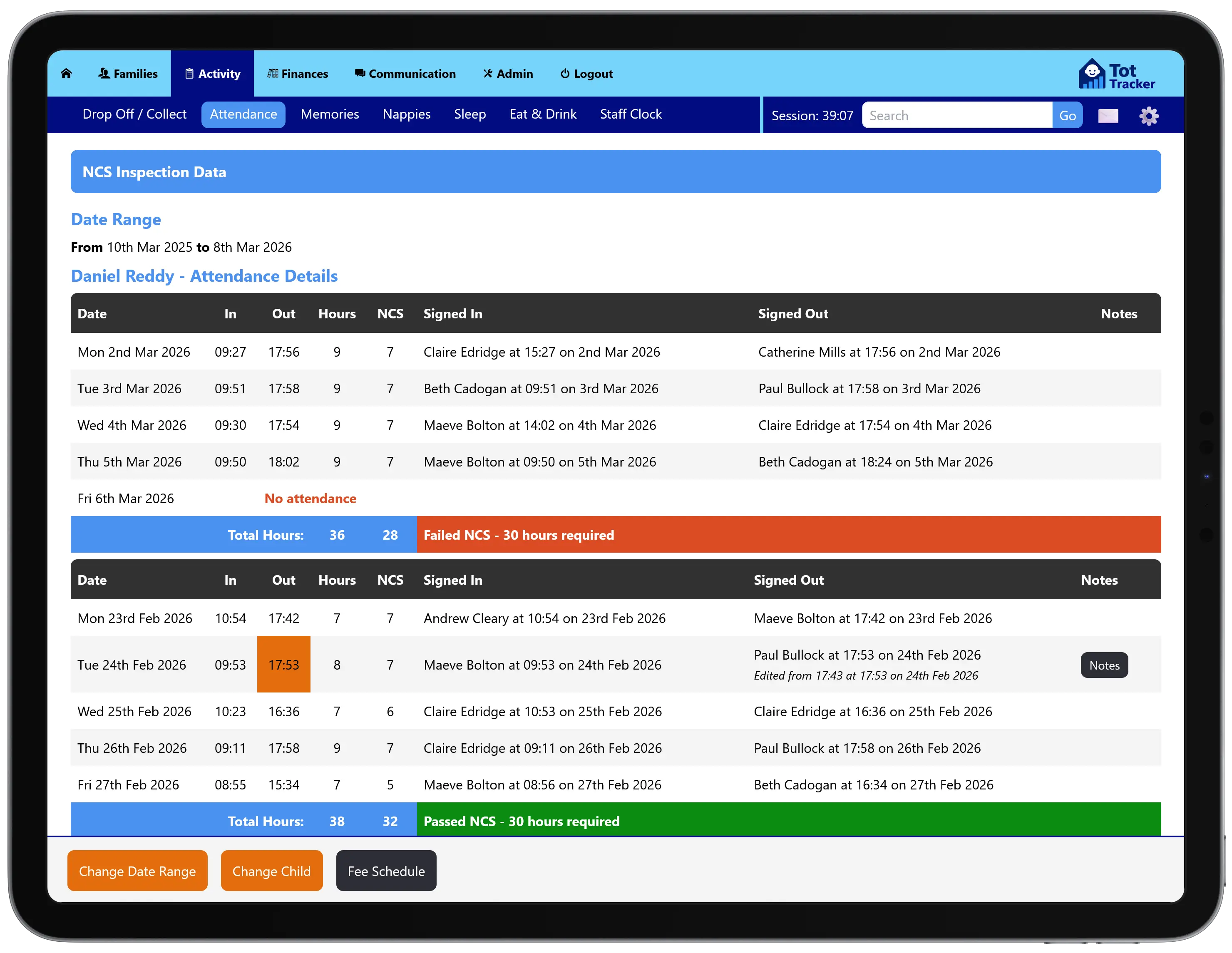
The dedicated NCS Inspection report, showing attendance, edit history, fee schedules and agreements for any date range.
See how this works in practice with a walkthrough of your own setup. Book a free demo →